Create a brand that resonates and Converts
FREE 3-Day Mini-Course
Join me for a FREE mini-course, where I'll show you how to build a strong and strategic brand foundation!
Send me the course!


If you’ve ever felt stuck in your business, struggled with imposter syndrome, or wondered how to stand out in an industry that feels increasingly saturated… this one’s for you.
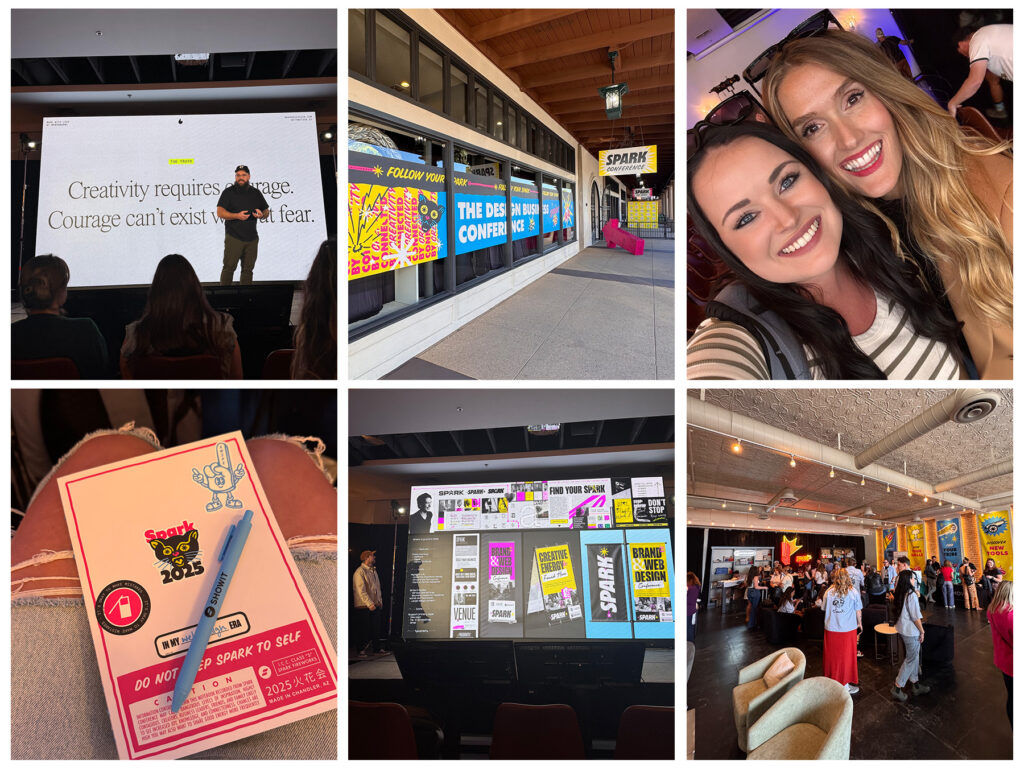
I just returned from Showit’s Spark conference in Chandler, Arizona, and I’m bursting with insights that I know will resonate with you too. Whether you’re a designer working solo from home, questioning your worth in the age of AI, or simply craving permission to do things differently, the speakers at Spark delivered transformational wisdom that’s too good not to share.
Below, I’ve compiled my favorite takeaways from four incredible keynotes. These aren’t just my notes – they’re actionable strategies for building a memorable brand, embracing your uniqueness, making more money, and overcoming perfectionism. I hope they inspire you as much as they’ve inspired me. Enjoy!
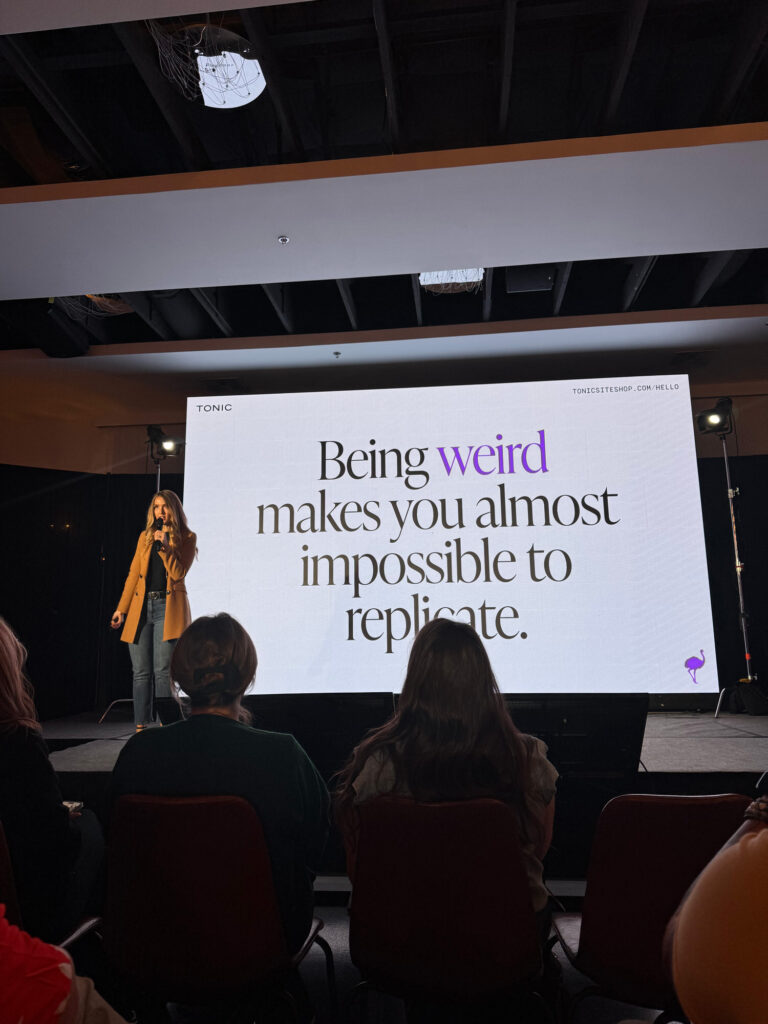
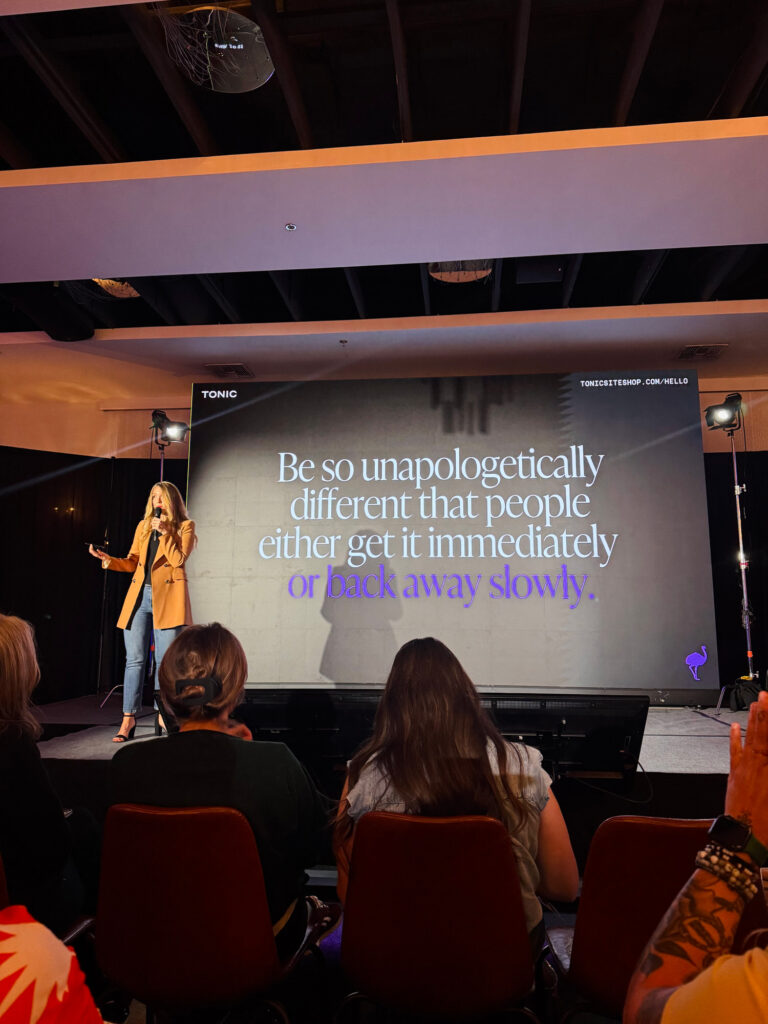
1. Jen Olmstead: Purple Ostrich: Building a Brand People Remember in a World Trained to Forget
Spark’s description of keynote: Before building one of the most recognizable design brands online, TONIC’s Jen Olmstead was just a precocious kid on a weird Texas ranch, unknowingly learning lessons that would shape her future. In this story-rich keynote, she shares why most businesses don’t last—no matter how beautiful—and what it really takes to stay top of mind. You’ll hear the messy truth behind TONIC’s middle years and uncover the art and science of creating a brand that makes people say, “Omg, I need this,” before they even know what you’re selling.
Key Takeaways
“Being weird makes you almost impossible to replicate. Being weird isn’t just allowed, it’s your entire competitive advantage.”
Jen reminded us that in the past, marketing had to be broad. With only TV, radio, and print ads available, brands had to appeal to everyone. But today’s landscape has completely flipped. AI and SEO algorithms are designed to reward specificity, not generality. Your Instagram feed is proof—it’s hyper-personalized to your exact interests, not some watered-down version meant for the masses.
The advantage of being small and unique? “You don’t need to be the best, you need to be the only.” (Quote by Kevin Kelly) No one wants something made for everyone. They want something made specifically for them. You can’t market to an 80-year-old grandma and an 18-year-old girl at the same time. You can’t be everything to everyone. Instagram won’t promote content that feels too broad, and trying to please everyone will suck the life out of you.
“When did you decide being who you are isn’t profitable?”
This quote hit me hard. We need to give ourselves permission to stand out and be different. To chart our own courses. To follow our guts. To stop trying to please a market and instead do what we’re meant to do, made to do, and what makes us happy.
Jen shared a wild story from her childhood on an ostrich farm. She taught us that ostriches are bizarre creatures. Ostriches are the fastest animal on land, can survive in a desert, can kill a lion, and lay eggs the size of bowling balls. How weird, right? Another weird thing is when those ostriches would take off running, they had no idea how to stop. They’d crash into fences and die. So her family had to build rubber fences with rounded corners to stop them from dying essentially.
That’s us. We need to run at our fences over and over and find out what works. We can bounce back. The bigger risk isn’t that your business might fail if it’s weird, it’s that it definitely will fail if it’s not weird.
Our industry all sounds the same right now. Same polished version, same ChatGPT-sounding text, same aesthetic. This is actually the perfect time for you to be weird, to be different, to be memorably you.
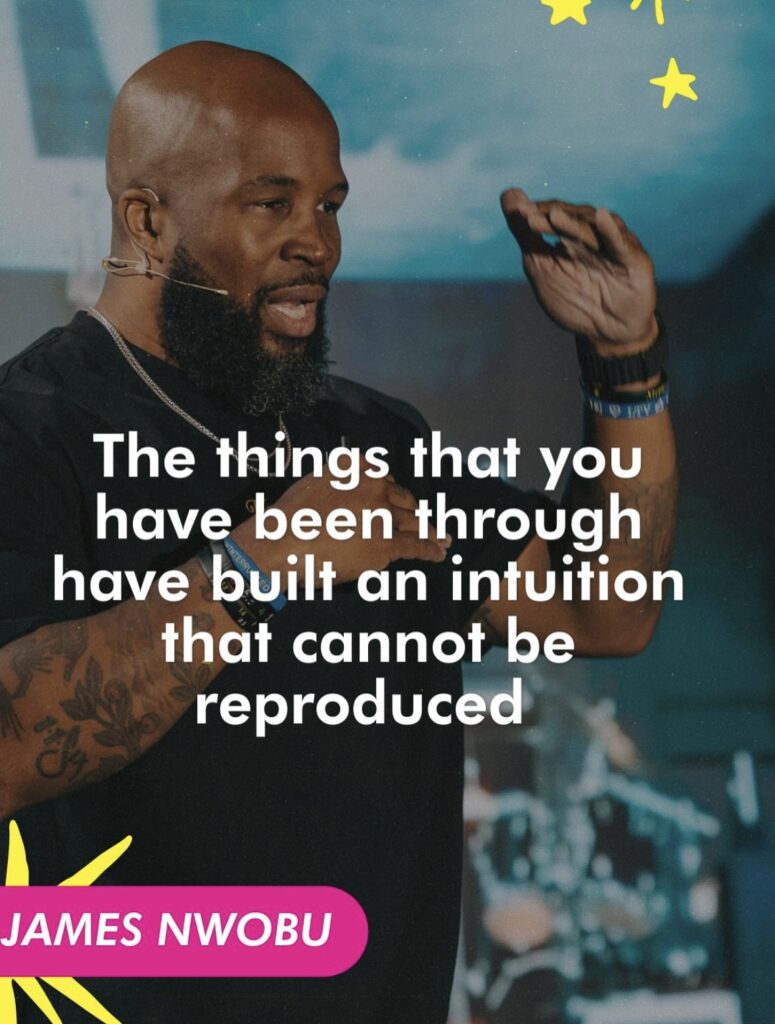
2. James Nwobu: The Undeniable Power of Your Personal Brand
Spark’s description of keynote: AI has a lot of people concerned, and rightfully so. Everyday, there’s another model, another tool, another feature that does what you used to do, but faster, arguably better, and apparently cheaper. How do you compete? And more importantly, where should you be investing your time, energy and resources so that you’re prepared to ride one of the biggest waves to ever crash your shore (and not be washed out by it)?
Key Takeaways
“The things that you have been through have built an intuition that cannot be reproduced.”
James shifted my entire perspective on AI. Yes, machines can do a lot and they’re incredible tools. No matter how great they are though, they can’t be you. They can’t be human. They don’t have your flaws, your voice, your taste, your life experiences.
The ironic thing? In our rush toward AI-polished output, we’re actually erasing what makes us memorable and human. The very thing that will set us apart in an AI-saturated world is our humanity… our mess, our voice, our unique perspective.
The 3 Best Investments You Can Make
James repeated his advice from last year because it’s that important: Get a counselor, hire a coach, and find a community.
Counseling is for context. It helps you face your own history and reclaim your story. The healthier you are as a person, the healthier your brand is. This is the best ROI you’ll ever get.
Coaching is for clarity. Coaches help you see what’s possible faster than you can on your own. James shared that he thought it would take him two years to run a six-minute mile. With a coach, he hit a 5:42 mile in just 10 weeks. He thought he knew what he was capable of, but his coach made him see differently.
Community is for courage. Business is hard. Doing it alone is even harder. Many of us are solo-entrepreneurs working from home in isolation, and that isolation burns us out more than the work itself. Real connection and face-to-face time is crucial. Community gives us our story, direction, and excitement back.
These three things are human-centered investments which is the antidote to AI anxiety and the foundation of both personal and professional success.
3. Dan Mall: Let’s Talk About Money
Spark’s description of keynote: In this Real Talk™ keynote, designer and entrepreneur Dan Mall shares the one simple reason you’re not making more money. It’s not the market, economy, or your clients. Dan will show you what it is and how it helped him grow a 7-figure agency for a decade with only two full-time employees and eventually sell it.
Key Takeaways
Four Actions to Make More Money
#1 – Expand Your Potential
Raise your ceiling by being more creative. Lower your floor by regulating your emotions.
How? You raise your ceiling through learning and doing. You lower your floor through therapy, boundaries, and managing limiting beliefs. The greater the distance between your ceiling and floor, the more you expand your potential. Your ceiling defines how high you can reach. Your floor defines how low you can go before you crack.
#2 – Pitch More
People can’t buy from you if they don’t know what you offer. Dan breaks pitching into two simple steps:
- First: “I have something you want.”
- Second: Your potential client will get more than they give up. Deliver change.
#3 – Charge 10%
Make someone else money, then ask for a cut. Help someone make $4 million and ask for $400,000. Help 50 people make $80,000 and charge $8,000. Help 200 people make $20,000 and charge $2,000. As Dan puts it: “Make someone else a lot of money and then ask for a little of it back.”
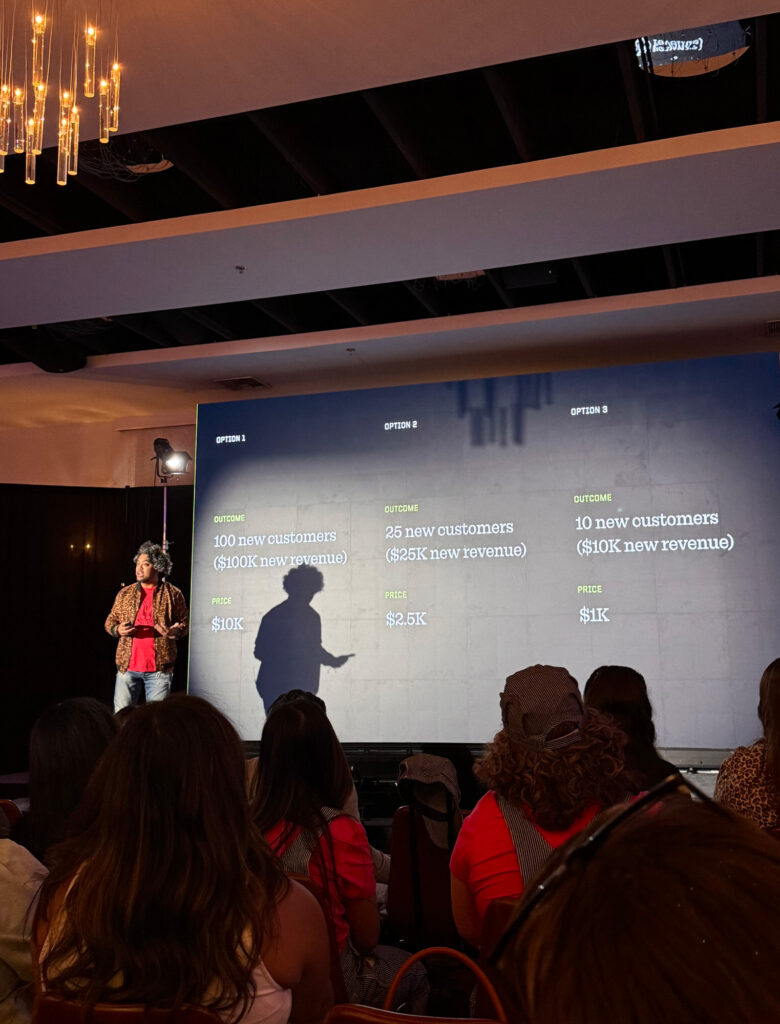
#4 – Always Give 3 Options
This pricing strategy is brilliant:
- Option 1: The price of all their wildest hopes and dreams. Show all your ambition for them here.
- Option 2: Priced around their budget (or what you think it might be).
- Option 3: Below their budget.
These options are essentially the same offering with different volume levels.
Instead of option 1, 2, or 3, Dan also suggests adding titles that mean something to the client. Working with a fantasy literary client? You could name your packages the Lion, the Witch, and the Wardrobe. When you use relatable names, you give clients another reference point they can understand. It makes money less abstract and more fun.
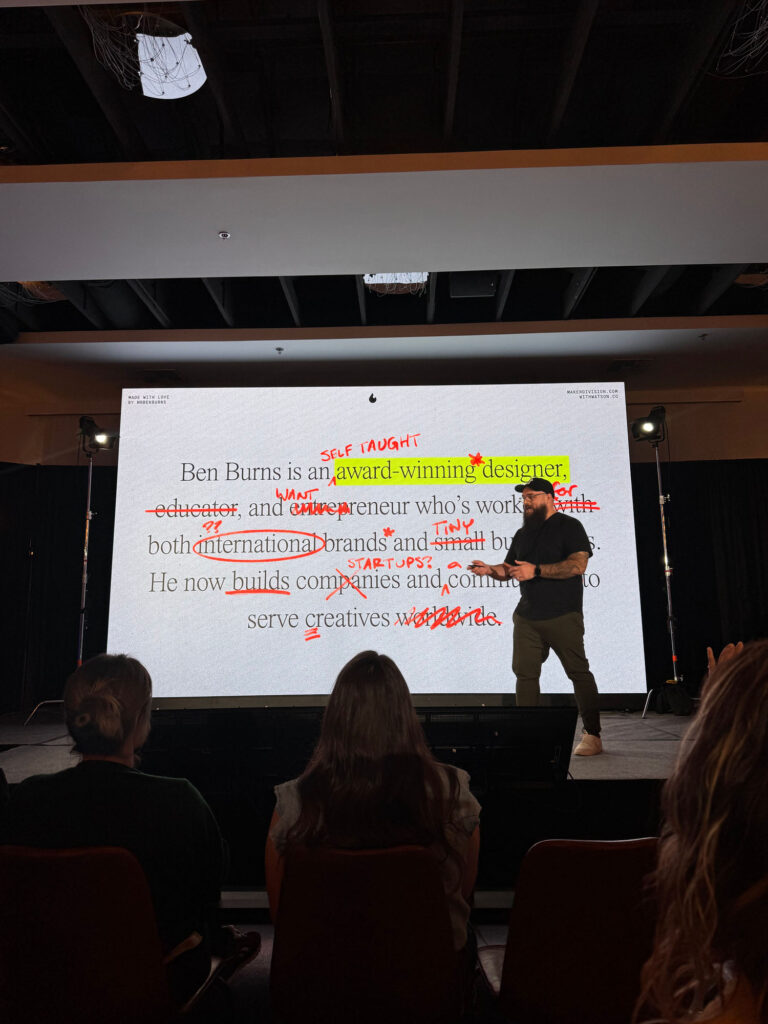
Ben Burns: The Imposter’s Guide to Imperfection – Why Done is Better Than Perfect
This keynote hit me especially hard. Perfectionism is something I really struggle with, and Ben’s message was exactly what I needed to hear. He walked us through personal stories to prove that the creative journey is less about being flawless and more about showing up despite the fear.
How to Reframe Imposter Syndrome
Imposter syndrome shows up everywhere… on sales calls, at networking events, while scrolling Instagram. It pops up whenever we step outside our comfort zone, and it doesn’t really go away until that comfort zone expands.
So we need to redefine it. Instead of seeing imposter syndrome as proof we’re not good enough, we need to see it as chances to either learn or help. When we focus on serving instead of performing, the pressure disappears. We become curious instead of fearful. We grow instead of shrinking.
Redefining “Perfect”
Ben challenged us to redefine the word perfect itself. Perfect keeps us planning, polishing, and feeling like we’re doing the right thing. But really? It’s just keeping us stuck. You know the pattern – never publishing your website, sitting on 100+ content ideas but never creating the content, etc.
Perfect should be defined as DONE. FINISHED. COMPLETED.
Chasing perfection keeps us stuck. Redefining it as “done” leads to momentum, growth, and improvement. Set a deadline. Make it public. For extra motivation, create a punishment if you don’t finish on time.
A fun fact that really stood out to me: Picasso is considered to have 50-100 masterpieces, depending on who you ask. However, Picasso created around 40,000 unique pieces of art. That’s two pieces a day for 90 years. All of the greats prioritize momentum over perfection.
Disarming Limiting Beliefs
Limiting beliefs are stories we tell ourselves to stay small, to stay in our comfort zone, to protect ourselves from failure. Here’s how to challenge them:
- Identify the limiting belief (it often hides behind the word “can’t”)
- Ask: Is this universally true for everyone without exception? If not, why does it have to be true for me?
- Examine the evidence: What proof supports this belief? Is it actually credible?
- Get perspective: What would someone who really loves you say about this? Would they want you to believe this about yourself?
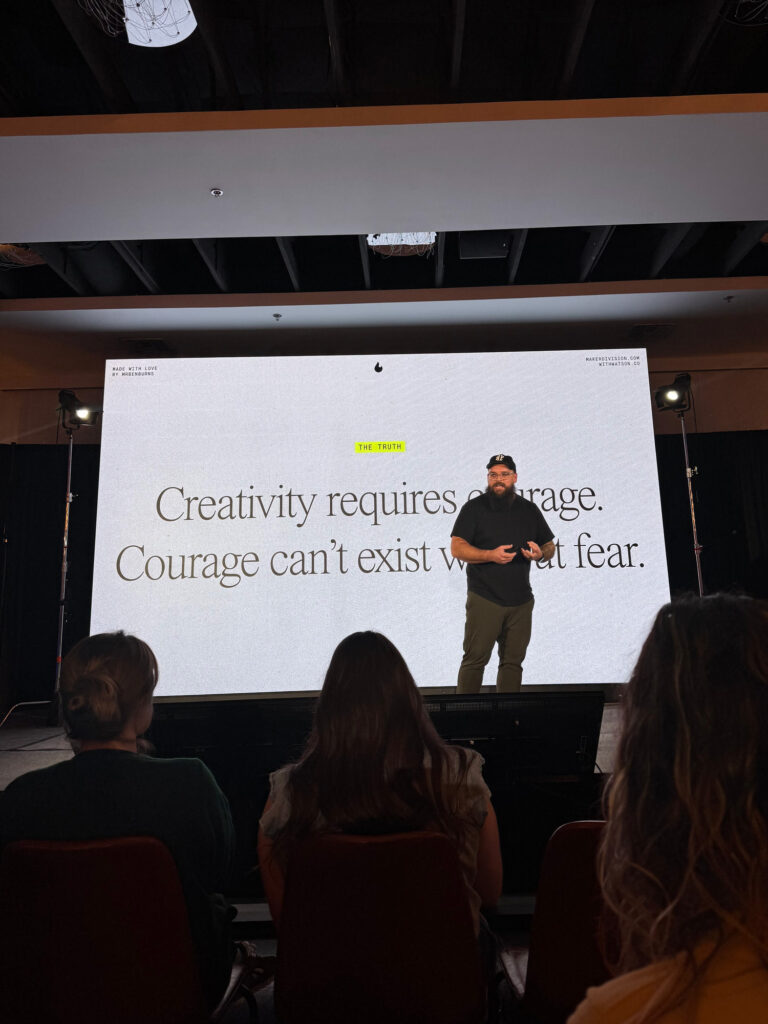
Creativity requires courage, and courage can’t exist without fear. They go hand in hand.
The next time you feel like an imposter, a fraud, or not ready, remember: Imperfect = I’m perfect.
Your Takeaways
So there you have it! Four speakers, dozens of insights, and hopefully a few lightbulb moments for you too.
If any of these takeaways resonated with you, I’d love to hear which one hit home. Maybe it’s Jen’s permission to be weird, James’ reminder to invest in your humanity, Dan’s pricing framework, or Ben’s challenge to redefine perfection. Whatever it is, I hope you’ll take one idea and run with it.
And if you’re a designer or creative entrepreneur looking for the best website platform and the most supportive community in the industry, I can’t recommend Showit enough. The team doesn’t just build incredible software, they invest in us as people. That’s rare, and it’s why I’m proud to be part of this community.
Ready to experience Showit for yourself? Snag a free month of Showit with my affiliate link.
Here’s to being weird, being human, and being perfectly imperfect.


